A research simulator for studying isolated collateral and constrained exits. Model two hypothetical claims: Earn supplies senior financing and Boost takes residual exposure. Scenario prices and limits are assumptions; nothing is minted, settled, or backed by real funds.
Indicative quotes · display onlyEmail sign-in, no wallet neededNo real mint or settlement
S
S&P 500SPYx · xStocks
Live
$773.72+0.11%
BoostEarn
You deposit$1,000.00
Entry fee · 0.10%$1.00
Senior capital matched$999.00
Stock exposure$1,998.00 · 2.00×
Senior claimYour junior equity
Review exposure
N
NVDAx$228.59
+0.48%
G
XAUT · Gold$4,342.03
-0.07%
Capacity checked5 of 5 gates passed
SSPYxS&P 500
QQQQxNasdaq 100
NNVDAxNVIDIA
TTSLAxTesla
AAAPLxApple
GXAUTTether Gold
6Bundled research scenarios
2.00×Illustrative Boost assumption
0.10%Entry fee on healthy vaults
5Modelled capacity checks
30sIndicative quote refresh target
Two claims, one modeled vault
Explore a hypothetical balance sheet.
The simulator models one tokenized asset and issuer per case. Its test-USDC ledger is local research state, not real collateral, custody, or an investment product.
Boost
Junior claim · residual exposure
Deposit USDC and hold up to 2.0× exposure to the stock through a Boost receipt. Senior financing covers the rest, so there is no personal margin call.
2.00× on the index and gold vaults, 1.50× on single stocks, recalculated live as prices move
0.10% entry fee; 1.00% only when a vault is stressed above 2.50×, paid to existing Boost holders
Exit to cash, or burn Boost and senior receipts together to take stock tokens in kind
Senior
Your Boost
Stock held
$1,000 into SPYx$1,998 exposure at 2.00×
Earn
Senior claim · financing yield
Queue USDC as senior financing for one vault. When a Boost entry matches it, your capital buys stock and your senior receipt starts accruing the vault’s funded APR.
Funded APR set per vault, from 5.50% on gold to 11.00% on Tesla
Priority over Boost in the loss waterfall. Junior capital absorbs losses first
Unmatched deposits stay withdrawable and never earn phantom yield
QueueUSDC waiting
MatchBoost entry
EarnSenior receipt
How the model works
Funded, checked, then simulated.
The local ledger models funding and exit constraints; it does not issue receipts or move real assets.
01
Choose one vault
Each vault pairs one asset with one issuer: SPYx, QQQx, NVDAx, TSLAx, AAPLx or XAUT gold. Nothing is pooled across vaults.
02
Fund both sides
Boost capital and senior financing are matched first. Unmatched money stays queued instead of pretending to be invested.
03
Pass five gates
Stressed exit depth, capital ceiling, issuer concentration, matched financing and a hard vault cap all have to clear.
04
Model, then compare
Scenario inputs drive the local ledger. Optional market quotes are indicative display data and never replace its reference prices.
Everything in the app
Every feature, explained.
Sign in once and the full workspace is yours: trading, risk tools, data and history, synced to your account.
Markets
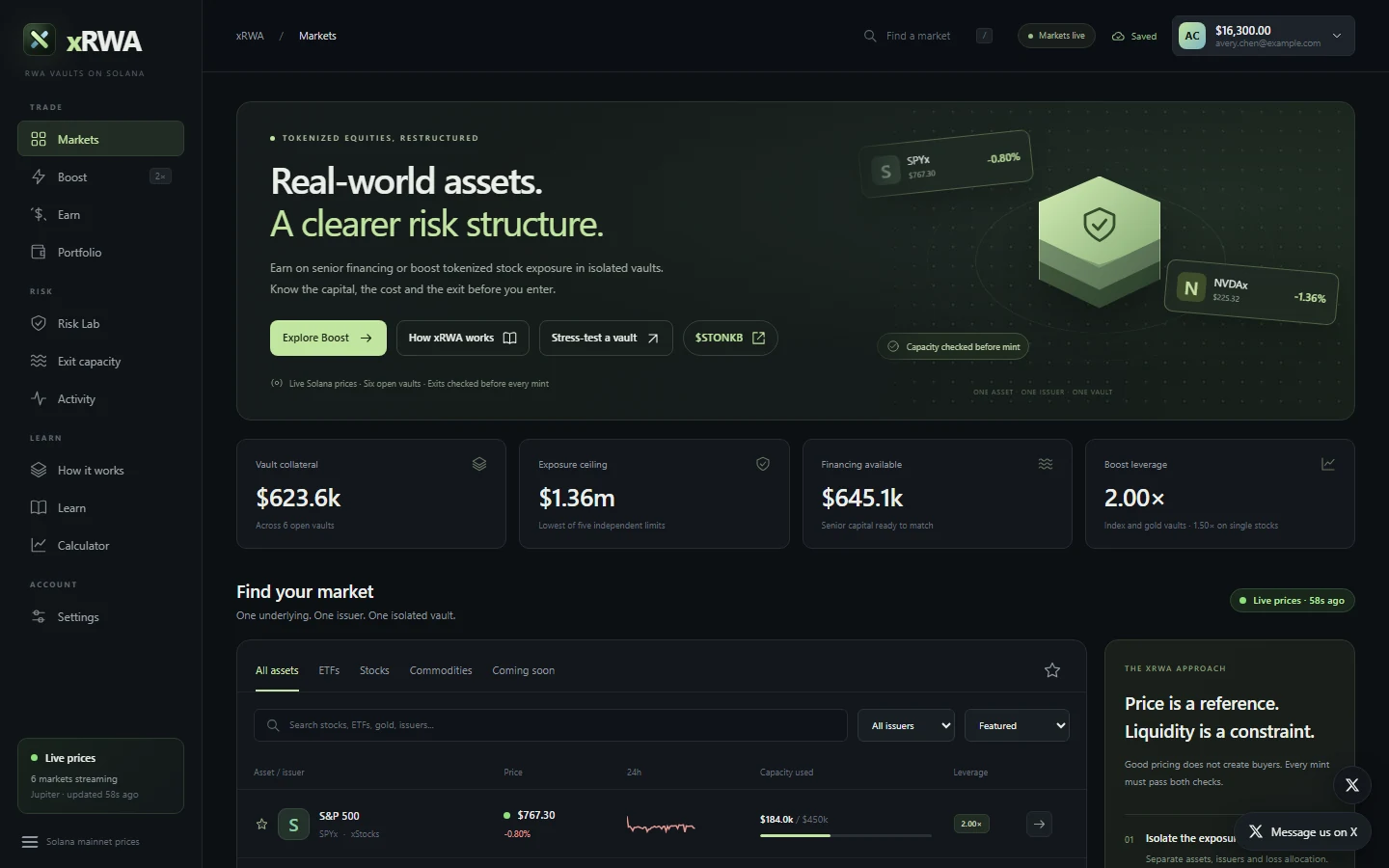
Bundled reference inputs and optional indicative market quotes, alongside modeled capacity and leverage. Search, filter by issuer or asset type, and keep a watchlist.
App › Markets
Boost scenarios
Explore up to 2.0× modeled residual exposure with a preview of fees, matched test-USDC, gross exposure, hypothetical claims and indicative market history.
App › Boost
Earn financing
Queue USDC for one vault, get matched by Boost entries and hold a senior receipt that accrues the funded APR every day.
App › Earn
Portfolio
Scenario account value, modeled positions, weighted-average cost basis, and hypothetical exits in one place. This is not a statement of real holdings.
App › Portfolio
Risk Lab
Shock the price, drain liquidity, remove the largest market maker, stale the oracle, freeze the issuer, close the session or depeg USDC. Then read the loss waterfall.
App › Risk Lab
Exit capacity
Lock USDC for 1 to 30 days as exit capacity for a vault. Commitments count toward the capacity gate, never double-count with financing and release at expiry.
App › Exit capacity
Issuer & oracle data
Cross-check the xStocks issuer price against the market, look up the Pyth feed each xStock registers, and export an evidence bundle sealed with a SHA-256 fingerprint.
Vault › Issuer & oracle
Activity journal
Every simulated match, exit, distribution and accrual, with local ledger details. Filter it, or export it to CSV.
App › Activity
Gains & losses calculator
Change one assumption (price move, horizon or match rate) and see fees, financing and cash-exit proceeds to the cent. Share any scenario as a link.
App › Calculator
Accounts & sync
Sign in with email and password. Positions, history and saved scenarios sync after every action. Export or import your whole workspace from Settings.
App › Settings
Learn hub
Eighteen in-app guides and tutorials, from exposure math to loss waterfalls, plus RWA articles on tokenization, xStocks, oracles and liquidity.
Session-closed, stale-price and issuer-freeze assumptions pause modeled price-dependent actions. These are local simulation rules, not live protocol controls.
App › Settings
Product tour
See it working.
Real screens from the xRWA app.
rwa.stonkbuilder.com/app/#/markets
Research scenarios
Six modeled cases. Three more listed.
Token identifiers support optional market-data lookups; they do not indicate collateral admission. Quotes are indicative, and rates and limits are illustrative assumptions.
Research scenario directory
Indicative market quotes · display only
Vault
Price
24h
Trend
Funded APR
Leverage
Status
S
SPYxS&P 500 · xStocks
—
—
7.00%
2.00×
Open
Q
QQQxNasdaq 100 · xStocks
—
—
7.60%
2.00×
Open
N
NVDAxNVIDIA · xStocks
—
—
9.50%
1.50×
Open
T
TSLAxTesla · xStocks
—
—
11.00%
1.50×
Open
A
AAPLxApple · xStocks
—
—
8.20%
1.50×
Open
G
XAUTTether Gold · Tether
—
—
5.50%
2.00×
Open
S
SPYonS&P 500 · Ondo
—
—
—
—
—
Coming soon
M
MUMicron · Backpack
—
—
—
—
—
Coming soon
O
OPENAIPre-IPO · PreStocks
—
—
—
—
—
Coming soon
Risk research
Price is a reference. Liquidity is a constraint.
These modeled checks illustrate how capacity rules could work. They do not admit real exposure, prove exit liquidity, or guarantee loss containment.
Five modeled admission checks
The lowest assumed limit binds in this research scenario. Here is an example TSLAx case.
Stressed exit capacityBinding · $100k
Capital risk ceiling$160k
Matched financing$145k
Issuer concentration$130k
Absolute vault ceiling$100k
When a gate binds, only new exposure stops. Existing positions are never force-sold because a limit moved, and splitting an order cannot bypass the per-batch cap.
The loss waterfall
Example: a −30% shock on a 1.5× vault. Boost absorbs the loss first; senior stays whole.
$150Stock before
$105After −30%
$50Senior paid
$55Boost left
Session closedNo route until the next session
Stale pricePrice-dependent actions pause
Issuer freezeNo cash or in-kind route
Under the hood
Accounting you can check to the cent.
xRWA runs on an exact-integer ledger: no floating-point money, no rounding that creates value, and no state change without a validated invariant check.
¢Exact-integer ledger
Every balance, fee and claim is integer cents or raw token units, validated after each action.
2Price layers
Bundled scenario inputs drive the ledger. Optional market quotes and issuer/oracle registry metadata are read-only observations, never settlement or valuation inputs.
RustSeparate Anchor prototype
A development artifact with Devnet-only fixture evidence; it is not deployed as an xRWA production protocol or connected to this local ledger.
APIOpen data API
Health, version, markets, price history and oracle routes, with a published OpenAPI 3.1 document.
No. Create an account with your email and a password. There is no seed phrase and no email code to wait for, and your workspace syncs to your account.
Is this real money?
No. The workspace uses non-redeemable test USDC on a research ledger. Public market references are indicative only; they are not verified valuation, an oracle update, or settlement authorization. Nothing here is investment advice.
What is the difference between Boost and Earn?
Boost is the junior claim. It takes up to 2.0× exposure to the stock (1.5× on single stocks) and absorbs losses first. Earn is the senior claim. It finances Boost positions and accrues the vault’s funded APR once matched, with priority in the loss waterfall.
Where do prices come from?
Bundled scenario reference prices drive the research ledger. Optional Jupiter market quotes, xStocks issuer prices and Pyth registry data are indicative/metadata-only observations; they do not change ledger values or authorize settlement.
What happens if a modeled stock price crashes?
The local scenario applies modeled losses to Boost before Earn. The example is an educational stress model only; no production vault, reserve, issuer control, or circuit breaker is operating.
Is xRWA on-chain?
No production xRWA protocol is deployed. This repository is a research frontend and test-USDC ledger. A separate program fixture has Devnet-only test evidence; it does not establish a live vault, verified oracle, audit, production readiness, or Mainnet deployment.
Open your xRWA account in under a minute.
Email and password. No wallet, no verification code. Start with 25,000 test USDC and every vault open.